
For researchers and compounders working with high-viscosity materials—rubbers, engineering resins, and bio-based polymers—the difference between a successful formulation and a failed experiment often comes down to three critical parameters: temperature profile, screw speed, and draw ratio. These are not merely settings to be dialed in arbitrarily; they are interdependent variables that determine melt quality, dispersion efficiency, and final product properties.
The HTPS conical counter-rotating двухшнековый экструдер from Hartek Technology provides the precision and flexibility needed to master these three pillars of extrusion. Below is a technical guide to understanding and optimizing each parameter for your specific materials.

1. Temperature Profile: The Thermal Foundation of Melt Quality
Why Temperature Profile Matters:
Different polymers require distinct thermal histories. Setting the correct temperature profile ensures:
- Complete melting without thermal degradation
- Optimal melt viscosity for consistent flow
- Proper additive dispersion
- Reduced pressure fluctuations at the die
2. Screw Speed: Balancing Shear, Throughput, and Residence Time
The HTPS-40 is equipped with a 1.3 kW servo motor with a rated speed of 1500 RPM and a maximum screw speed of 500 RPM. The servo drive offers precise speed control, allowing researchers to dial in the exact shear input required for each formulation.
Why Screw Speed Matters:
Screw speed directly influences:
- Shear rate: Higher speeds generate more mechanical energy, improving dispersive mixing but also increasing melt temperature
- Throughput: Speed determines output rate
- Residence time: Faster speeds reduce the time material spends in the barrel, which is critical for heat-sensitive polymers
- Filling ratio: Higher speeds help reduce the filling ratio of screw channels, which positively affects torque requirements
Speed Selection Guidelines:
- Heat-sensitive materials (PLA, TPU, PVC): Operate at lower speeds (50–150 RPM) to minimize frictional heating and shorten residence time
- High-viscosity rubber or heavily filled compounds: Higher speeds (300–500 RPM) boost shear for better dispersion
- General rule: Start at approximately 100 RPM and increase incrementally while observing melt temperature and motor current
3. Draw Ratio: The Bridge Between Extrudate and Final Product
The draw ratio—the relationship between the cross-sectional area of the extrudate exiting the die and the final product—is often overlooked but critically important for achieving desired mechanical and dimensional properties.
- Why Draw Ratio Matters:
- Draw ratio influences:
- Molecular orientation: Higher draw ratios align polymer chains, improving tensile strength
- Final dimensions: Determines the cross-sectional area of the finished product
- Surface quality: Affects smoothness and defect formation
- Mechanical properties: Impacts modulus, elongation, and toughness
Key Considerations for Draw Ratio Optimization:
- Material type: Amorphous polymers (PS, PC) can tolerate higher draw ratios than semi-crystalline polymers (PE, PP) which may undergo strain-induced crystallization
- Melt strength: Materials with higher melt strength (e.g., rubbers, elastomers) can withstand greater draw ratios without breaking
- Cooling conditions: The rate and uniformity of cooling after extrusion significantly affect how well the drawn dimensions are maintained
- Die design: The relationship between die exit area and take-up speed determines the actual draw ratio achieved
Practical Approach:
When developing new formulations on the HTPS-40, systematically vary the take-up speed while keeping extrusion parameters constant. Observe the relationship between draw ratio and:
- Filament/film diameter uniformity
- Surface defects (melt fracture, sharkskin)
- Mechanical properties of collected samples
Start-Up Procedure for Optimal Parameter Development
- Set temperature profile based on your material’s thermal properties (refer to the inverted-V guideline)
- Allow 30-minute heat soak for thermal equilibrium
- Start screw at low speed (5–20 RPM) and gradually increase to target
- Begin feeding slowly while monitoring the main motor current
- Adjust cooling as needed to maintain stable melt temperature
- Collect samples at various draw ratios to identify optimal conditions
- Document all parameters—the HTPS-40’s touchscreen HMI allows easy storage and recall of successful recipes
From Lab to Production: Scale-Up Confidence
The conical screw geometry of the HTPS-40 closely mirrors that of industrial-scale conical twin-screw extruders. This means the temperature profiles, screw speeds, and draw ratios you optimize on this 40 mL unit can be transferred directly to production lines as startup parameters—not approximations, but directly applicable data.
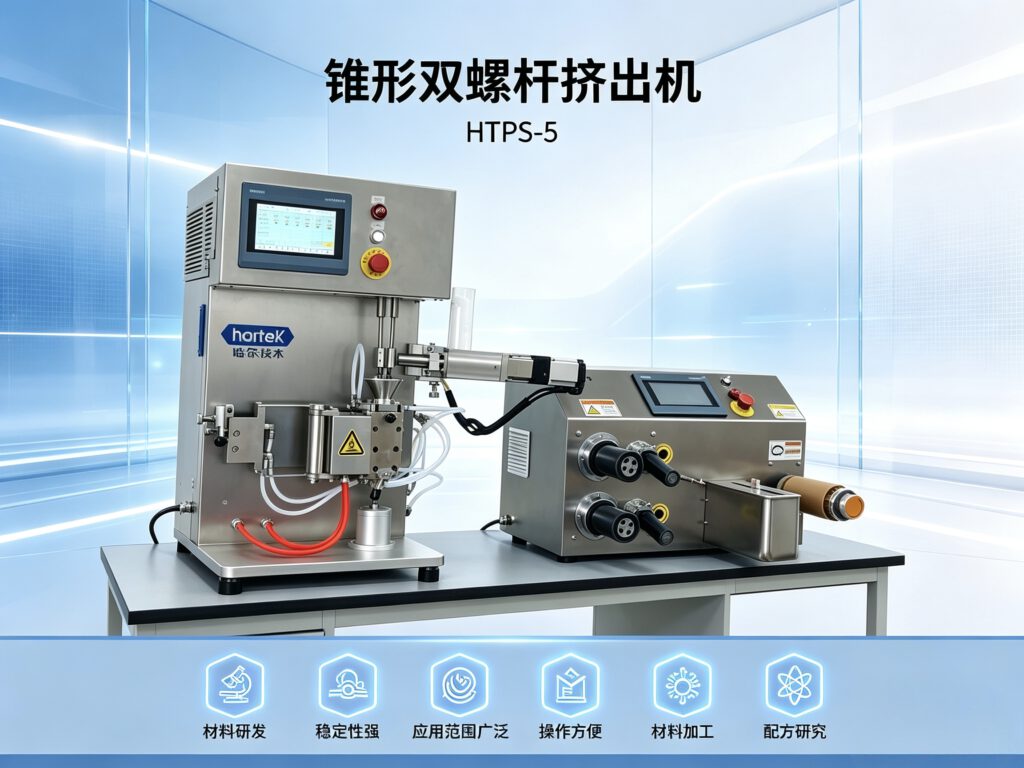
Specification of Conical Twin-Screw Extruder
| No. | Параметр | Conical Twin-Screw Extruder Specification / HTPS-5 |
|---|---|---|
| 1 | Вместимость | 40 mL |
| 2 | Servo Motor Power | 1.3 kW, rated speed 1500 RPM |
| 3 | Max Screw Speed | 500 RPM |
| 4 | Диаметр винта | Conical Φ5.4 / Φ25 mm, length 240 mm |
| 5 | Screw Structure | One‑piece integral screw design |
| 6 | Screw Material | 38CrMoALA (nitrided steel) |
| 7 | Направление вращения | Counter‑rotating / Co‑rotating (switchable) |
| 8 | Бочка | Split‑type (clamshell) barrel structure, material 440C stainless steel |
| 9 | Heating Zones | 6 zones, 200 W per zone |
| 10 | Max Operating Temperature | 350 °C |
| 11 | Cooling System | Combined air and water cooling |
| 12 | Mixing Modes | Dual‑mode design with diverter valve – freely switchable between circulation mixing and extrusion modes |
| 13 | Control Interface | Touchscreen HMI control |
| 14 | Overall Dimensions (L×W×H) | 550 × 650 × 1000 mm |

 Russian
  English
  Arabic
  German
  Spanish
  French