
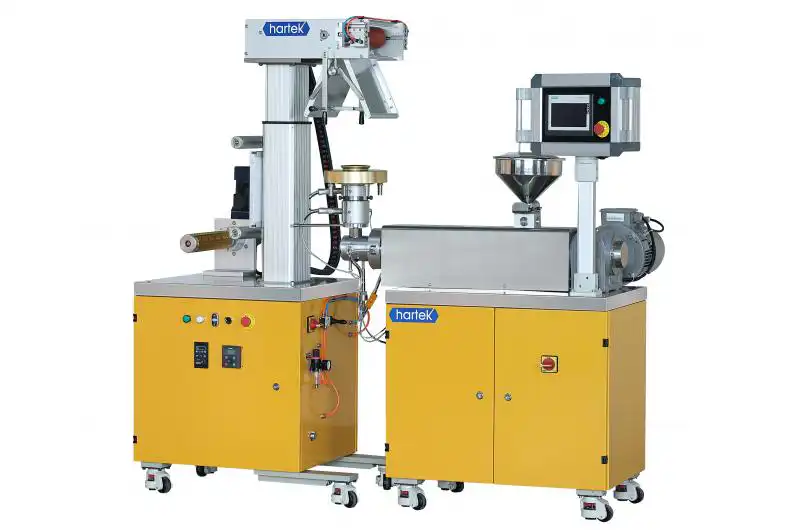
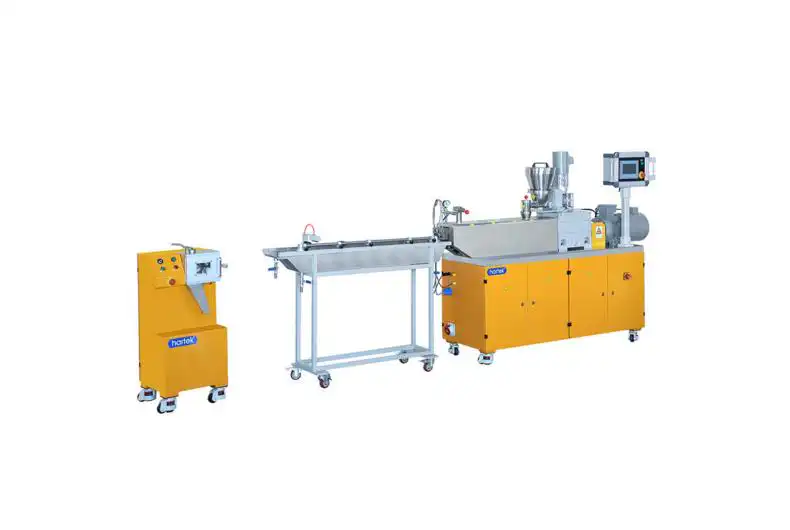
The 3D filament extrusion line consists of a precision single-screw extruder, wire die, water cooling system, wire storage system, traction system, diameter measuring instrument system, winding system, and measurement and control system, which can realize functions such as wire extrusion, cooling, diameter measurement, and winding.
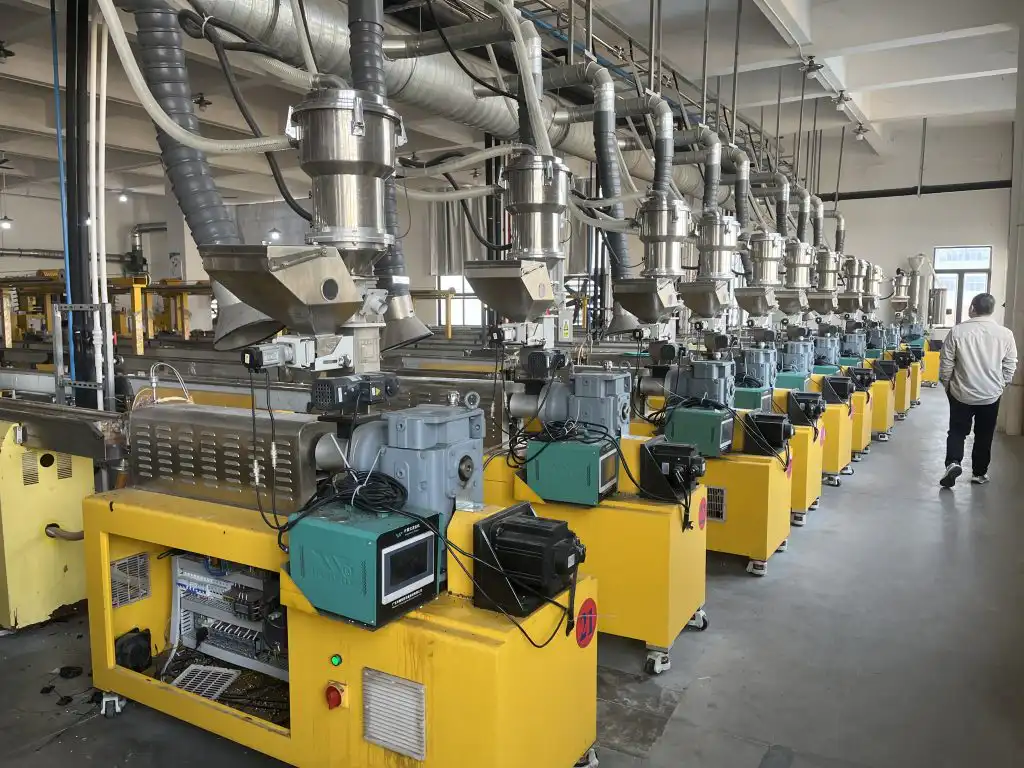
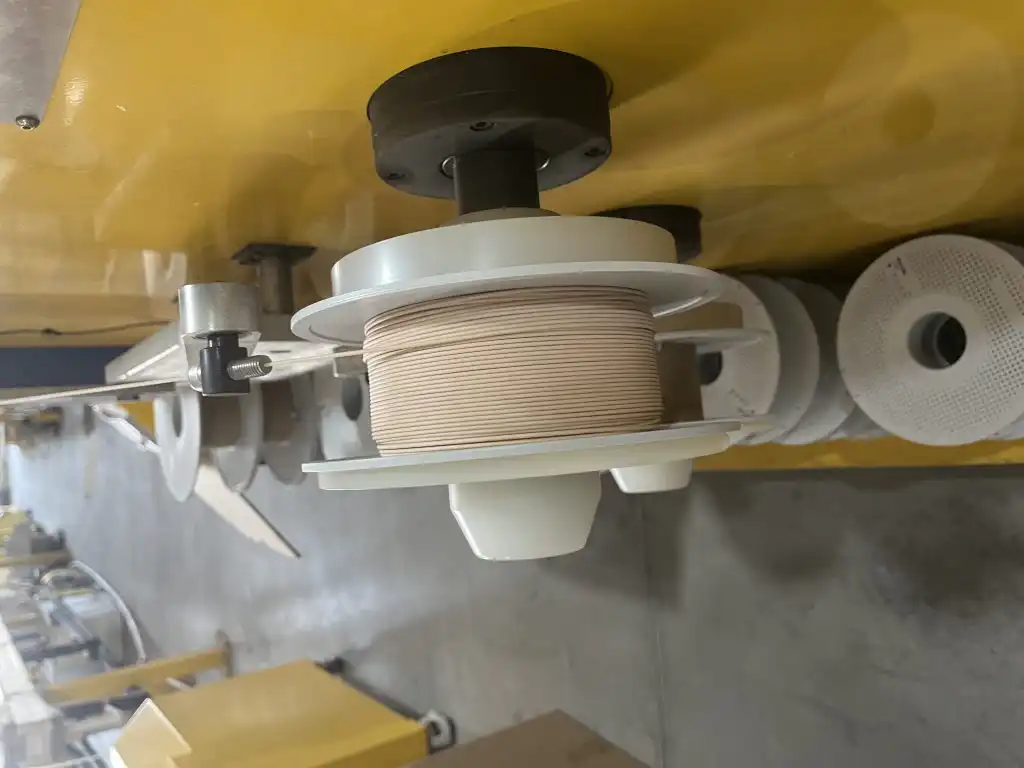
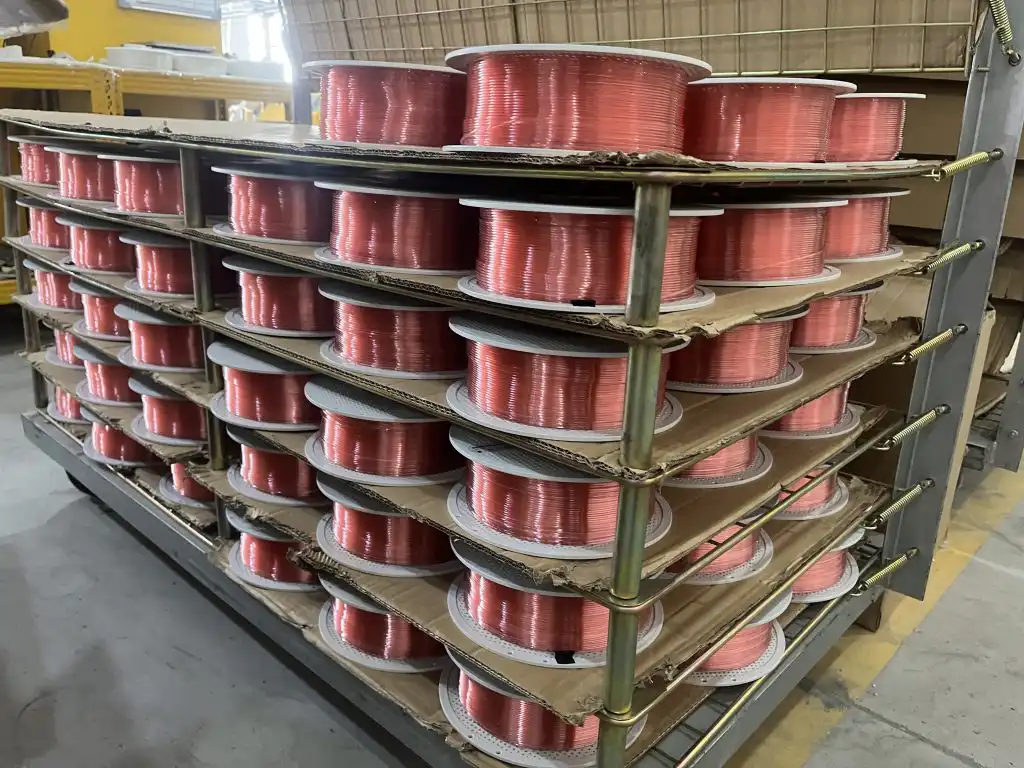
3D Filament Extrusion Line Working Principle
A filament extruder is an advanced molding device primarily used to produce plastic granules for 3D printing. Its working principle mainly includes the following key steps:
- Raw Material Input
Particle Conveying: Dried and processed granular plastic material is fed into the extruder via a conveying mechanism.
Preheating Stage: During conveying, some material may be slightly heated to ensure it reaches the required melting temperature.
- Heating and Melting
Heating System: The granular material is melted into a liquid state using heating methods such as steam, hot water, or electric heating wire. The melting system typically includes multiple heating zones to ensure uniform temperature distribution.
Temperature Control: A closed-loop control system precisely regulates the melting temperature to avoid overheating or underheating.
- Shaping and Molding
Die Design: The extruder is equipped with various die shapes, such as round, square, and hexagonal, to meet different types of 3D printing needs.
Extrusion Process: Rotary Extrusion: The molten material is extruded into the die through the coordinated work of the die core and the heating system. The die core typically employs a rotating or advancing design to ensure a uniform cross-section and continuity.
Gas Phase Control: During extrusion, the amount of molten gas is appropriately controlled to avoid residue and bubble formation.
- Cooling and Curing
Cooling System: The material is cooled from its molten state to below room temperature using methods such as fans, water cooling, or air cooling. During cooling, it is necessary to prevent crystallization or excessive hardness from affecting material properties.
Curing Process: For some materials, such as ABS, additional curing steps may be required, including light irradiation or other chemical reactions.
Discharge and Collection: Collection Piping: The cooled material is collected into collection piping for subsequent conveying and packaging.
Product Performance
- High-strength European standard integrated frame, 304 stainless steel desktop, practical and aesthetically pleasing.
- High-performance servo motor, wide speed range, more stable speed.
- User-friendly structural design, more convenient operation.
- Traction and diameter measuring instrument form a closed-loop control, enabling rapid response to changes in extrusion speed.
Applications of 3D Printing Filament Extruder
- Performance testing of polymer material filament extrusion molding.
- Plastic filament formulation design.
- Optimization and control of plastic filament extrusion process parameters.
- Used for extruding single/multi-cavity, multi-specification plastic filaments.
- Process optimization, cost control, and small-scale production, etc.
 English
  Arabic
  German
  Spanish
  French
  Russian