
For polymer film researchers, the path from a promising new formulation to a production-ready product is rarely straightforward. You know the scenario all too well: a carefully developed formula that performs beautifully in the lab, yet demands kilograms of expensive engineering plastic just for a single trial run on production-scale equipment. Film thickness fluctuates unpredictably. Uniformity remains elusive. And perhaps most frustrating of all—lab-scale success that simply refuses to translate to the production line.
These are not minor inconveniences; they are fundamental barriers to innovation. Lab Film extrusion line involves complex interactions between material rheology, thermal history, and mechanical precision. Common issues such as inconsistent melt temperature, pressure fluctuations, and poor screw design can lead to gauge variations, optical defects, and mechanical property inconsistencies. Addressing these challenges at the R&D stage is critical—yet traditional lab equipment often lacks the precision and flexibility required for meaningful development work.
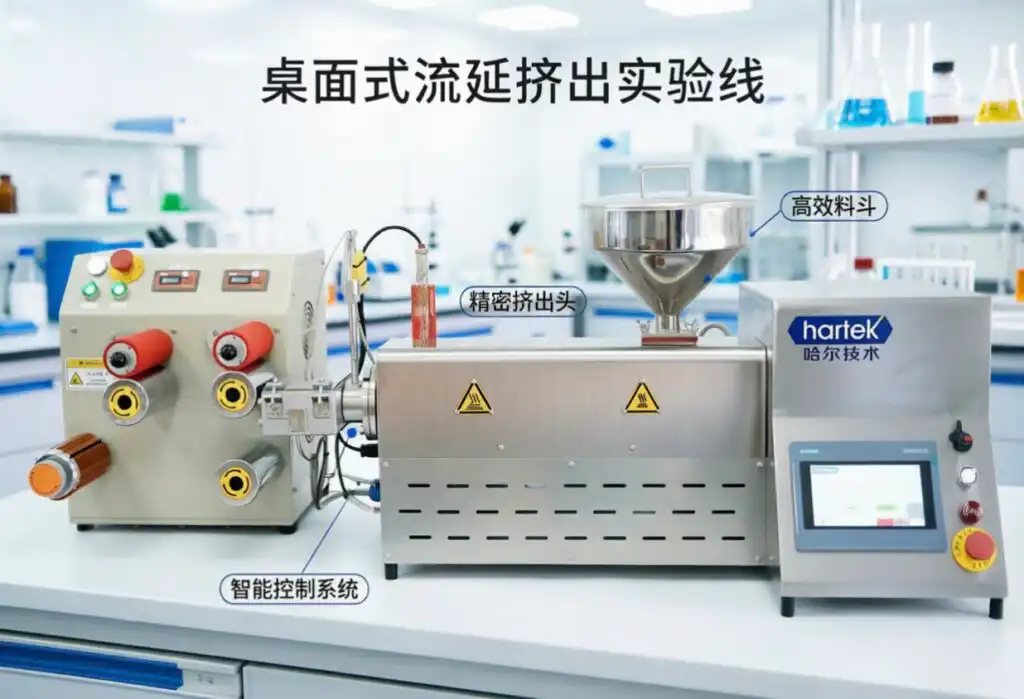
The MT16 Lab Film extrusion line Solution: Technical Capabilities That Drive Results
The MT16 benchtop film extrusion line from Hartek Technology is engineered specifically to overcome these hurdles. Here is a technical breakdown of what makes it an indispensable tool for film researchers:
- Gram-Scale Material Consumption for Maximum Formulation Agility
With a minimum feed requirement of just over 100 grams and an output range of 0.1–2 kg/h, the MT16 enables researchers to validate new formulations with minimal material consumption. This is transformative for those working with expensive specialty polymers or limited-quantity experimental materials. Rather than committing kilograms of costly resin to each trial, you can run multiple iterations on the same budget—accelerating the development cycle while reducing waste.
- Precision Temperature Control Across Multiple Zones
The MT16 features multi-zone independent PID temperature control with an accuracy of ±1°C and a maximum operating temperature of 350°C. This level of precision is essential because different polymers—whether standard PP, PE, or high-performance engineering plastics—require distinct thermal profiles to achieve optimal melt quality. Precise temperature control prevents thermal degradation, ensures consistent melt viscosity, and directly contributes to film quality and reproducibility.
- Superior Film Thickness Uniformity
The MT16 produces films ranging from 0.02 to 0.5 mm in thickness and up to 80 mm in width. This capability ensures that samples produced are of sufficient quality and consistency for meaningful performance testing—whether you are evaluating mechanical properties, optical clarity, or barrier performance. Uniform film thickness is the foundation upon which all subsequent material characterization is built.
- Modular Design: One Machine, Multiple Processes
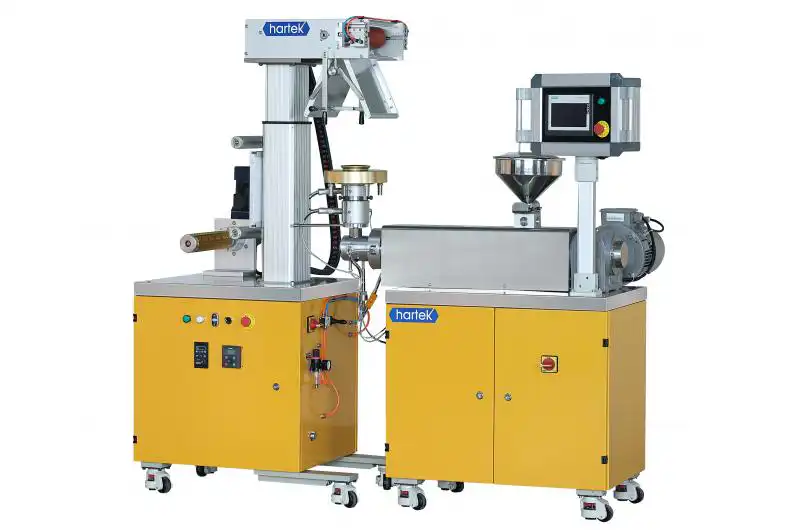
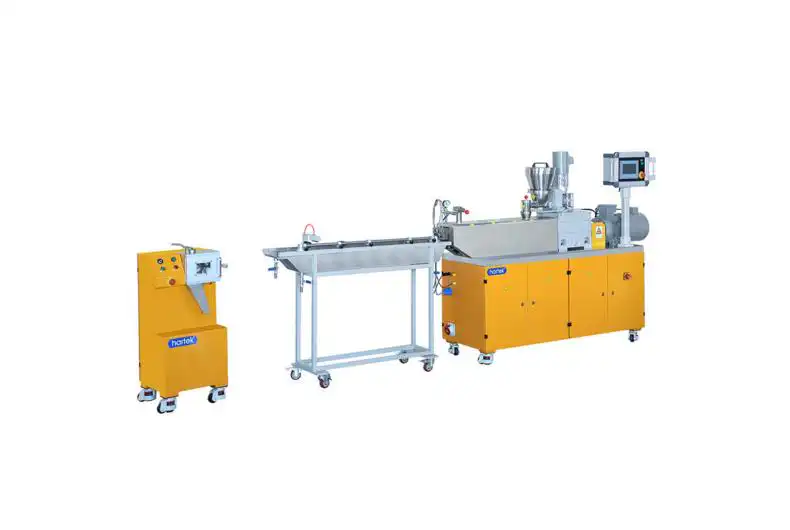
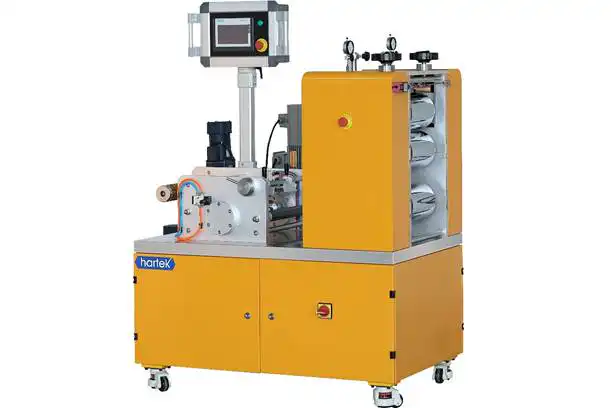
Perhaps the most distinctive feature of the MT16 is its modular architecture. By simply changing the die and downstream equipment, the same main unit can perform film extrusion, cast film, blown film, pelletizing, wire coating, and tubing. This versatility is invaluable for R&D environments where multiple process types must be explored with limited equipment budgets and floor space.
- Compact, Lab-Friendly Footprint
Occupying less than 1 square meter and requiring no foundation work, the MT16 fits on a standard laboratory benchtop. This desktop design makes advanced film extrusion R&D accessible to university labs and corporate research centers alike—eliminating the need for dedicated industrial spaces.
- PLC Intelligent Control with Recipe Storage
The MT16 incorporates PLC-based intelligent control with recipe storage functionality. This allows researchers to save and recall process parameters precisely, ensuring experimental reproducibility across multiple runs. Combined with internationally branded melt pressure and temperature sensors, the system delivers high-precision data that researchers can trust.
From Laboratory to Production Line
The ultimate objective of any R&D effort is successful scale-up. The MT16 is designed to generate data that directly informs production-line process settings. By achieving reliable, repeatable results at the lab scale, researchers can confidently transfer optimized parameters to full-scale manufacturing—reducing the risk and cost associated with scale-up failures. Hartek Technology’s commitment to supporting researchers from laboratory to production
 English
  Arabic
  German
  Spanish
  French
  Russian