
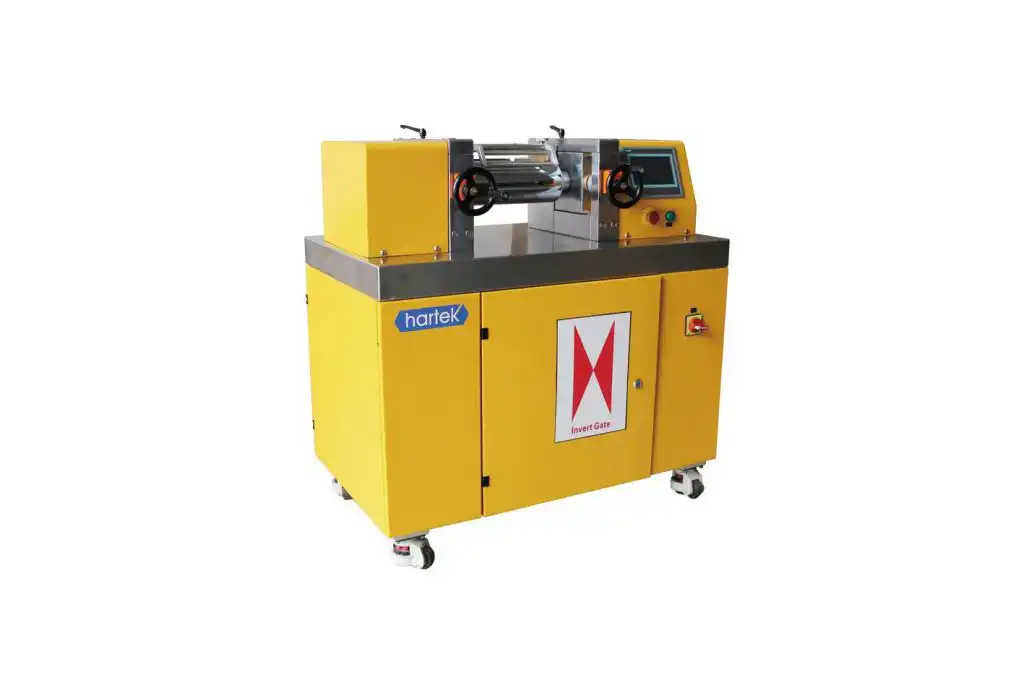
The structure of a two-roll open mixing mill is not complex: two parallel rolls rotate relative to each other at different speeds. Material is drawn into the roll gap (roll distance) and subjected to intense shearing and compression. Water or oil can be circulated inside the rolls for heating/cooling, thus controlling the material temperature.
The core parameter here is the speed ratio (the ratio of the linear velocity of the front roll to the rear roll). Typically, the speed ratio is between 1:1.1 and 1:1.5. A higher speed ratio results in stronger shearing and better dispersion, but also faster heat generation. The speed ratio of laboratory-grade open mills is mostly adjustable to meet the needs of different materials.
Soft integration point: Our laboratory open mill uses independent variable frequency motors to drive the front and rear rolls, with a speed ratio that can be steplessly adjusted within the range of 1:1.05–1:1.5, and is equipped with an independent roll temperature control system (room temperature–200℃).
Advantage 1: Flexibility in Small-Batch Experiments
While internal mixers offer significant advantages in output and automation, they have an inherent drawback: a very large minimum feed amount. A typical laboratory internal mixer requires a minimum effective feed amount of 50–200 grams, while an open mill only needs tens of grams or even a few grams of material to complete one mixing cycle.
For university research groups or corporate R&D centers, this means:
Faster screening of new material formulations, avoiding waste of expensive modifiers;
Multiple formulations can be performed simultaneously (e.g., filler content of 0.5%, 1%, 2%), instead of waiting for each batch;
Easy cleaning and material change, requiring only a small amount of the same rubber compound to “wash the rollers,” without disassembling the drum.
Advantage 2: “Visibility” of the Mixing Process
This is the most unique and easily underestimated advantage of the open mill. An internal mixer is a closed chamber; you can only infer the mixing state through indirect signals such as temperature, pressure, and torque. The open mill, however, is open, allowing direct observation:
Whether the rubber compound evenly coats the rollers;
Whether the powder has been incorporated;
Whether there are any detached, stuck, or scorched particles;
The surface gloss and color uniformity of the flakes.
This direct observation is extremely important for experience accumulation and process judgment. Many mixing problems in production (such as poor dispersion or localized over-mixing) are precisely identified through small-scale trials using an open mill.
Soft Integration Point: Our laboratory open mills come standard with a transparent safety shield (openable), ensuring safety without obstructing the operator’s view.
Advantage 3: Flexible Discharge, Applicable to Various Material Forms
The discharge of a two-roll mill is highly flexible: you can obtain sheets, strips, ribbons, or even thin sheets directly. This makes it suitable for a variety of subsequent tests:
Compressing into test pieces for mechanical property testing; Cutting into strips for vulcanization characteristic testing; Directly producing sheets for thickness measurement or lamination.
In contrast, internal mixers output blocks or granules, requiring additional two-roll milling or sheeting for sample preparation. The two-roll mill combines the “mixing + forming” steps into one, saving time and equipment investment.
Limitations and Proper Selection of Open Mixing Mill
Of course, open mills are not a panacea. Their limitations are also apparent:
Low output: The maximum single feed rate is typically no more than 1–2 kg (laboratory type);
Relatively low temperature control precision: The open structure leads to rapid heat loss, making it difficult to precisely control the temperature profile like an internal mixer;
Operation relies on experience: Roll gap, roll temperature, and the technique of forming triangular bundles all affect the results, requiring a certain level of operator skill.
Therefore, a reasonable configuration approach is: open mills for initial screening and formula exploration, and internal mixers for scale-up verification and small-batch production. The two are not substitutes, but rather complementary.
How to Choosing a Laboratory Open Mixing Mill?
If you’re purchasing an open mixing mill for your laboratory or R&D center, don’t get bogged down in fancy features. Focus on these four key points:
Roll Material and Surface Hardness: At least HRC 55 for wear resistance and scratch resistance. Chrome-plated rollers are more corrosion-resistant than ordinary steel rollers.
Temperature Control Method: A dual-circuit system with electric heating and oil/water cooling is the most practical. Single heating or single cooling will limit the range of materials that can be processed.
Speed Ratio Adjustment: Prioritize independent front and rear roller drives (dual motors) over gear drives. The former allows for stepless speed ratio adjustment, while the latter requires gear replacement.
Safety Devices: Multiple protections are essential, including emergency stop, reverse rotation, and knee pressure switch. Open mixing mills are open-type equipment; safety design cannot be compromised.
Safety Features: Our laboratory open mixing mills use chrome-plated alloy rollers (hardness HRC 58–62), dual-circuit temperature control, independent variable frequency motor drives, and come standard with three emergency stop devices. It supports a minimum feed amount of 15g, meeting the needs of all scenarios from formula screening to small-batch preparation.
 English
  Arabic
  German
  Spanish
  French
  Russian