
A micro twin-screw extruder from Hartek has been installed, commissioned, and operated by a university in Qingdao, Shandong Province, and has been officially delivered to the customer’s laboratory for use.
This equipment is specifically designed for the blending and modification of trace polymer materials, formulation screening, and small-batch preparation of high-value materials. Its compact structure and efficient mixing capabilities will provide key technical support for the customer’s sophisticated R&D projects.
The newly delivered micro twin-screw extruder features a co-rotating twin-screw structure with a screw diameter of 11.7 mm and a length-to-diameter ratio of 40:1. Compared to traditional laboratory extrusion equipment, its significant advantage lies in its ability to complete a full blending and granulation experiment with a single feed amount as low as tens of grams. This makes it particularly suitable for formulation exploration and process parameter optimization of expensive materials (such as medical polymers, specialty engineering plastics, and bio-based materials). The machine integrates the extruder, electrical control system, and optional micro-granulation unit, and can be placed on a standard laboratory bench, requiring minimal laboratory space.
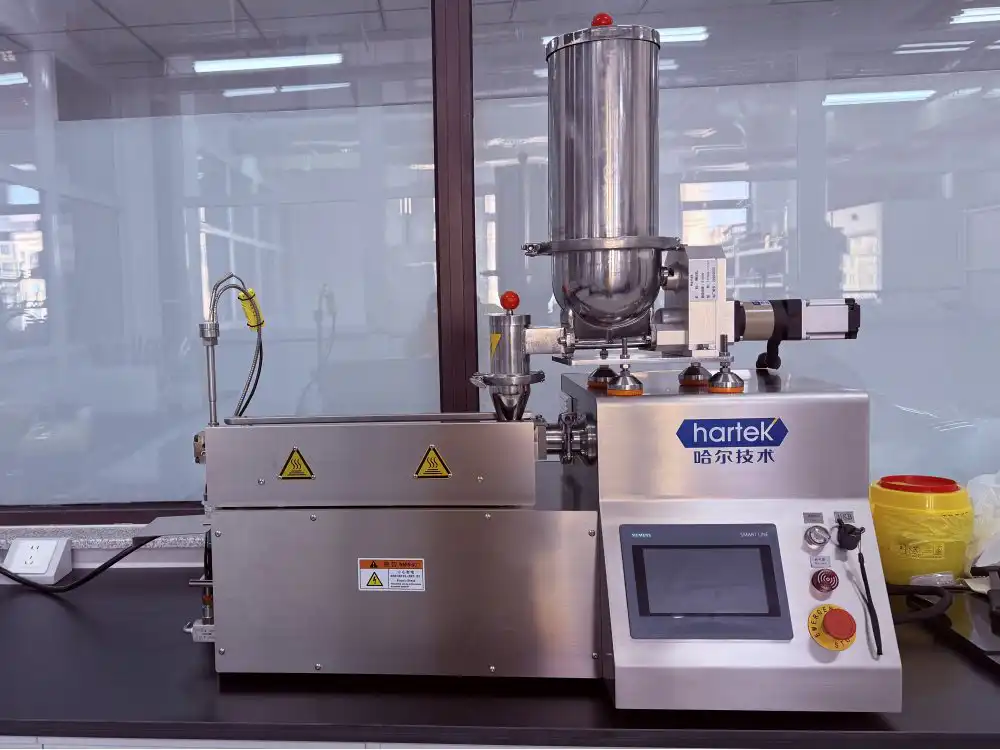
The equipment engineers first completed the main unit positioning, electrical connections, and online debugging of each unit to ensure the stable and coordinated operation of the extrusion system and temperature control system. Subsequent operational training focused on equipment functions and process control, including:
Micro-feeding operation: Material addition methods and hopper cleaning points for small batches;
Process temperature setting: Setting heating temperatures for each zone of the cylinder based on material characteristics, and low-temperature start-up and constant temperature control for heat-sensitive materials;
Melt state observation and recording: Monitoring and identifying anomalies in melt pressure and temperature parameters during normal operation;
Extrusion and sample collection: Traction operation and sample collection methods for extruded strips;
Material change and cleaning procedures: Screw cleaning, die disassembly, and equipment cleaning steps when switching between different formulations, with a focus on rapid cleaning techniques for micro-feeding equipment;
Daily maintenance and calibration: Heating element inspection, thermocouple calibration cycle, and key points for equipment inspection.
 English
  Arabic
  German
  Spanish
  French
  Russian