
In the mixing of rubber and plastics using an open mill, the problem of roller sticking not only severely slows down production efficiency but also makes cleaning time-consuming and labor-intensive. Furthermore, repeated roller sticking can cause localized overheating of the rubber compound, thus affecting the mixing quality. So, why does roller sticking occur? In most cases, it’s due to a mismatch between three core parameters: temperature, rotational speed, and roller gap. These will be analyzed in detail below.
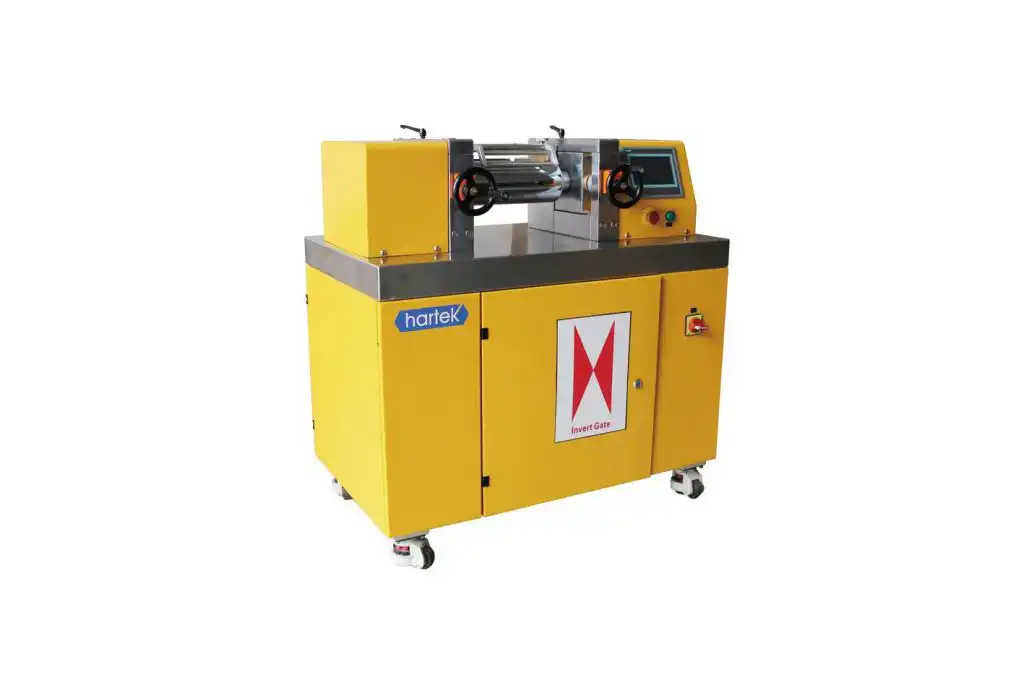
I. Temperature: The Most Direct Influencing Factor
Improper roller temperature control is the primary factor causing rubber compound to stick to the rollers.
When the roller temperature is too high, the temperature of the rubber compound at the contact surface with the roller rises rapidly. The viscosity of the rubber compound near the roller decreases, and its fluidity increases, making it easy to penetrate into the microscopic pits of the roller and form adhesion. This is especially true for rubbers with inherently high viscosity, such as natural rubber and styrene-butadiene rubber, which are at higher risk of sticking to the rollers at high temperatures.
When the roller temperature is too low, the hardness of the rubber compound increases, and its fluidity decreases, causing it to accumulate and stagnate at the roller gaps. During repeated tumbling, it is also prone to sticking to the roller surface.
Adjustment Recommendations:
The temperature of the front roller should generally be 5-10°C lower than that of the rear roller to facilitate the rubber compound coating the front roller.
Different rubber types have their own suitable temperature windows: natural rubber is generally controlled at 50-60°C; nitrile rubber needs to be even lower, at 40-50°C; and chloroprene rubber should not exceed 50°C.
If roller sticking has already occurred, you can try applying a small amount of stearic acid or a release agent to the roller surface, but this is only a temporary measure. To fundamentally solve the problem, you need to adjust the temperature.
II. Rotation Speed and Speed Ratio: A Double-Edged Sword of Shear Force
The rotational speed of the rollers and the speed ratio between the front and rear rollers determine the magnitude of the shear force experienced by the rubber compound.
If the speed ratio is too high, the shear force is excessive, resulting in rapid heat generation. This causes intense friction between the rubber compound and the rollers, leading to significant localized temperature rise and increasing the risk of roller sticking during mixing.
If the speed ratio is too low, the shear force is insufficient, resulting in poor dispersion of compounding agents and inadequate tumbling of the rubber compound on the rollers, also easily leading to localized adhesion.
Adjustment Recommendations:
The commonly used speed ratios for open mills are between 1:1.1 and 1:1.3. A slightly higher speed ratio is acceptable for plasticizing, while a slightly lower ratio is preferable for mixing.
When roller sticking occurs, the rotational speed can be appropriately reduced to decrease the heat generated by shearing.
If the rubber compound has already wrapped around the rollers but slippage occurs at the bottom, the speed ratio can be fine-tuned to improve feed.
III. Roller Gap (Clearance): The “Regulator” of Rubber Compound Inventory
The size of the roller gap directly affects the amount of rubber compound accumulated and the pressure state at the roller gap.
If the roller gap is too small, the rubber compound throughput decreases, the accumulated rubber does not tumble sufficiently, and the residence time at the roller gap is short, making it easier for heat to accumulate, thus causing the rubber compound to stick to the roller.
If the roller gap is too large, too much rubber accumulates, and the rubber compound repeatedly folds at the roller gap but cannot pass through smoothly, resulting in excessive local pressure, which can also cause the rubber compound to stick to the roller.
Adjustment Recommendations:
In the initial stage of mixing, the roller gap can be slightly larger, maintained at 3-5mm, to facilitate the entry of rubber compound and the addition of compounding agents.
After adding fillers, gradually reduce the roller gap to 1-2mm to improve shear dispersion.
If roller sticking occurs, try appropriately increasing the roller gap to reduce the pressure on the accumulated rubber compound.
IV. Coordinated Adjustment of Three Key Factors
Temperature, rotational speed, and roll gap are not isolated variables; they influence each other. For example:
- When the roll temperature is too high, the rotational speed can be appropriately reduced to decrease the heat generated by shearing.
- If the speed ratio is large, the roll temperature should be appropriately reduced to offset the effect of frictional heating.
- When the roll gap is reduced, the amount of rubber material passing through decreases. In this case, the rotational speed can be fine-tuned to maintain smooth material feeding.
- When encountering problems with mixing and sticking to the rolls, it is recommended to check each factor in the following order: first adjust the temperature, then the roll gap, and finally the speed.
V. Other Influencing Factors
Besides the three factors mentioned above, the following factors may also lead to roller sticking:
- Rubber compound formulation: Excessive filler oil content and improper proportions of certain polar additives will increase the likelihood of roller sticking.
- Roller surface condition: Roller surface wear, scratches, or chromium peeling will significantly increase the risk of roller sticking.
- Addition sequence: Adding the softener too early will soften the rubber compound, making it easier for the roller to stick; adding it too late will lead to poor dispersion.
 English
  Arabic
  German
  Spanish
  French
  Russian