
Longitudinal streaks are one of the most troublesome problems in cast film machine experiments—periodic or random patterns appear along the traction direction, sometimes fine like sharkskin, sometimes coarse and twisted. Many people’s first reaction is “the die is clogged” or “the material is bad,” and then they blindly clean and change materials, but the problem keeps recurring. In fact, the essence of longitudinal streaks is melt fracture, and the shape of the streaks directly tells you the type of fracture and the direction of adjustment. This article teaches you to diagnose with the naked eye, without parameter tables, and know how to adjust by looking at the streaks.
I. Understanding Two Types of Melt Fracture: Viscous Fracture vs. Elastic Fracture
As the melt is extruded from the die slit, it is subjected to both shear and tension. When the extrusion speed exceeds the material’s tolerance limit, the melt “collapses”—this is called melt fracture.
| Fracture type | Stripe features | Root cause |
|---|---|---|
| Viscous rupture | Fine, periodic, perpendicular to the flow direction (sharkskin-like) | The shear rate at the die head wall is too high, causing the melt to “tear”. |
| Elastic fracture | Coarse, twisted, irregular, and spiral-shaped along the flow direction. | The elastic energy stored in the melt is suddenly released, causing the melt to “convulse”. |

II. Viscous Rupture (Sharkskin): Decrease velocity or increase temperature
Visual Diagnosis:
The membrane surface resembles sharkskin, with fine, regular transverse ripples (perpendicular to the traction direction).
This typically appears at higher extrusion speeds and disappears as the speed decreases. It is commonly found in high-viscosity materials (such as PET and high-MI PP).
Why does this happen?
The melt is subjected to extremely high shear rates at the die wall, causing the surface to be “dragged” and fractured, but the interior remains intact. This is like forcefully pushing a wet paper towel; the surface tears first.
What you shouldn’t do: Never lower the temperature! Lower temperatures will increase viscosity and worsen the fracture.
III. Elastic Fracture (Spiral): Heating or Additives
Visual Diagnosis:
The streaks are large, twisted, and irregular, extending along the traction direction (longitudinal).
Sometimes they appear spiral or bamboo-like, and even the entire melt curtain vibrates.
They usually appear suddenly at medium speeds and persist for a period after deceleration.
Why does this happen?
The melt is stretched and stores elastic potential energy within the die, which is suddenly released upon exiting the die, causing the melt to “twitch.” This is common in materials with a very narrow molecular weight distribution (such as certain metallocene polyolefins and high molecular weight PMMA).
What Not to Do:
Never reduce the speed! For elastic fracture, reducing the speed is often ineffective and may even change the streak period without eliminating it. The solution must be to reduce elasticity.
IV. Rapid Verification on a Desktop Cast Film Production Line
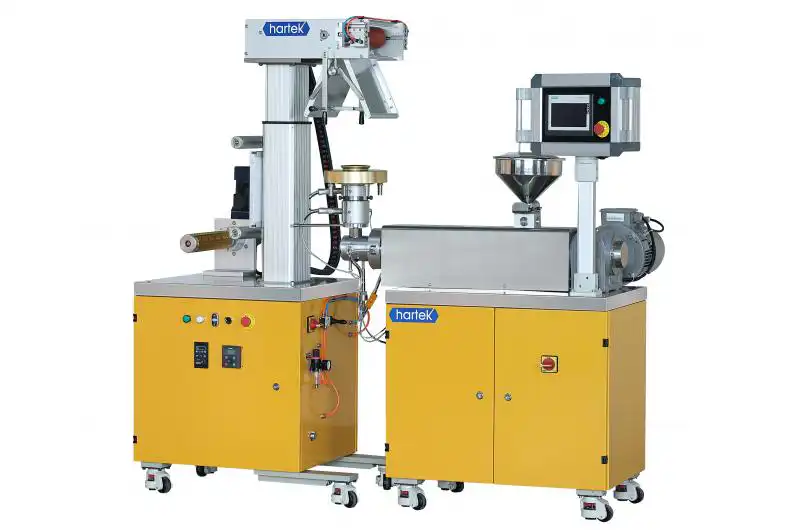
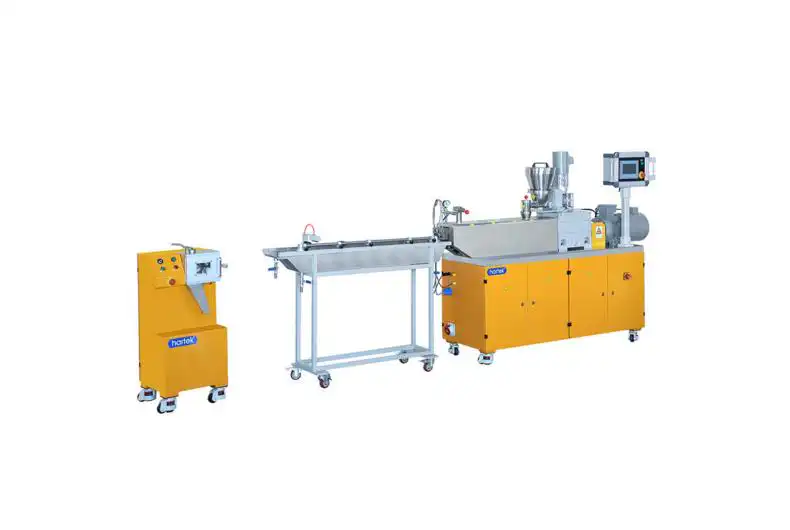
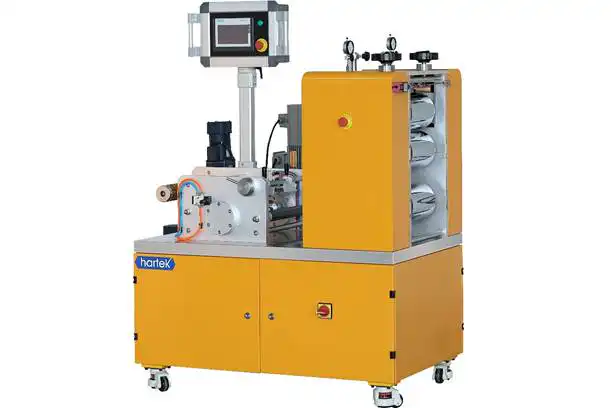
Desktop cast film production lines, due to their short screws and small dies, make it easier to observe the critical point of melt fracture, and require less raw material (500g is sufficient for speed scanning). Recommended procedure:
Fix the barrel and die temperatures.
Gradually increase the traction speed from low to high (while matching the extrusion rate).
Record the “critical speed” at which streaks appear.
Adjust the speed according to the streak morphology as described above and observe whether the critical speed increases.
 English
  Arabic
  German
  Spanish
  French
  Russian