
In the research and development and trial production stages of rubber and polymer materials, the lab two-roll mill is a key piece of equipment for elastomer compounding. Its operational precision affects the uniformity of the compound, the repeatability of experimental data, and the performance of subsequent processing. To ensure stable and repeatable compounding results, it is necessary to understand the core process parameters and be able to effectively identify and resolve common defects.
Lab Two-Roll Mill Elastomer Mixing Technology Guidelines: Key Parameter Control and Typical Defect Handling
Control of core process parameters
- Roller Temperature
Roller temperature is a key variable in controlling the viscoelasticity and chemical rate of the rubber compound.
Key Control Points: Low temperatures increase the hardness of the rubber compound and make it difficult to feed; high temperatures may cause roller sticking or scorching. A temperature difference between the front and rear rollers needs to be set to maintain stable rubber coating.
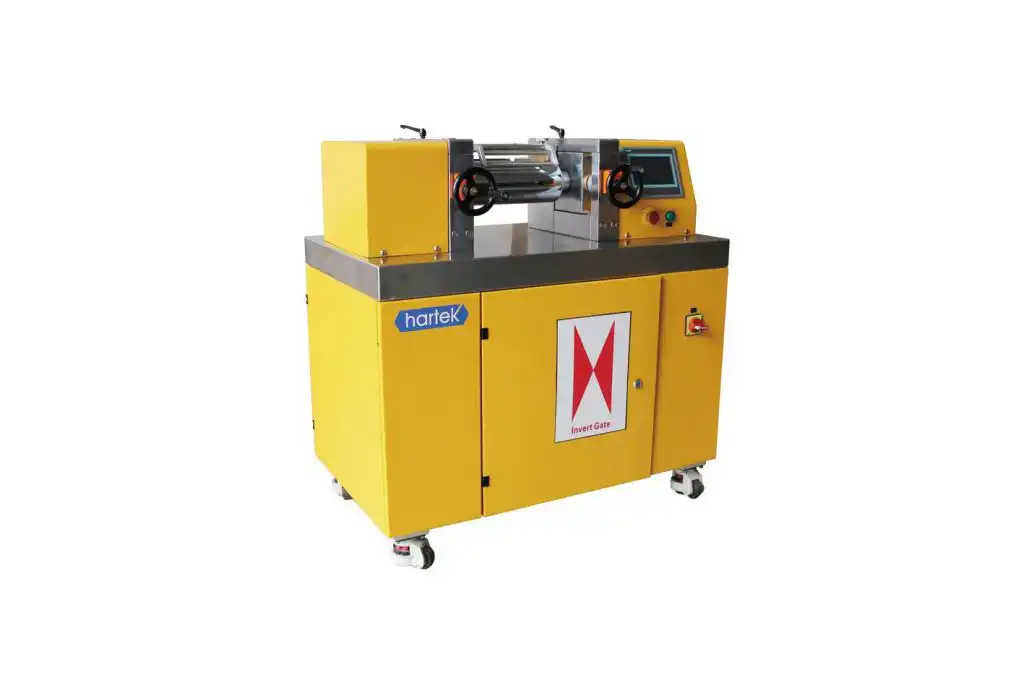
Operating Recommendations: Set the temperature range according to the type of elastomer. For example, when using a Hartek Technology HTR-120 open mill, its ±2℃ temperature control accuracy can effectively prevent localized overheating and achieve a uniform temperature distribution.
- Roller Gap
Roller gap determines shear strength and distribution characteristics.
Key Control Points: Too small a roller gap leads to excessive shearing, intense heat generation, and low feed efficiency; too large a roller gap results in insufficient shearing force and poor filler dispersion.
Operational Recommendations: Use a step-by-step adjustment strategy. In the initial plasticizing stage, set a larger roller gap (e.g., 1.5-2.5mm) to promote rubber compound wrapping around the rollers; after adding filler, gradually reduce the roller gap (e.g., 0.5-1.5mm) to enhance the shearing effect. Maintain an appropriate amount of accumulated rubber during operation and ensure continuous tumbling.
- Mixing Time and Operation
The mixing time and operation method together determine the total amount and uniformity of energy input.
Key Control Points: Insufficient mixing time will lead to uneven dispersion; excessive time may cause molecular chain degradation or scorching.
Operational Recommendations: Follow the standard feeding sequence: raw rubber → activator/antioxidant → filler → plasticizer → vulcanizing agent. Ensure overall uniformity by observing the appearance and feel of the rubber compound and adhering to the operating procedures.
Common Defects and Their Causes and Countermeasures
- Poor Dispersion
Symptom: Rough rubber compound surface with visible undispersed powder particles.
Causes: Insufficient shear force due to excessive roller gap; insufficient mixing time; excessively rapid filler addition rate.
Countermeasures: Reduce roller gap to enhance shear; extend mixing cycle; adopt a slow, batch-based feeding method.
- Scorching
Symptom: Premature vulcanization of the rubber compound during mixing or storage, resulting in loss of fluidity and reprocessing ability.
Causes: Excessively high roller temperature; excessively long mixing time, especially after adding vulcanizing agent; improper timing of vulcanization system addition.
Countermeasures: Immediately reduce roller temperature; strictly control the addition of vulcanizing agent at low temperatures (e.g., when the rubber compound temperature drops below 100℃) and quickly mix and sheet; verify the scorching safety of the formulation.
- Sticking to Rollers or Detaching
Symptom: Excessive adhesion to rollers or inability to stably wrap around rollers.
Causes: 1. Roller sticking: Often caused by excessively high temperature, overly soft rubber compound, or excessive plasticizer in the formulation; roller detachment: Often caused by excessively low temperature, overly hard rubber compound, or unreasonable temperature difference between the front and rear rollers.
- Countermeasures: When sticking to the roller, try lowering the roller temperature or adjusting the formulation; when detaching from the roller, appropriately increase the roller temperature, especially the rear roller temperature, to guide the roll wrapping.
- Blooming
Phenomenon: Frosty powder appears on the surface of the compound or vulcanized rubber.
Causes: Oversaturation of compounding agents (such as sulfur, accelerators, antioxidants) in the rubber compound.
- Countermeasures: Check and adjust the formulation to ensure that the amount of compounding agents is within their solubility limits; ensure uniform mixing; control the ambient temperature of the rubber compound storage environment.
- Bubbles and Inhomogeneity
Phenomenon: Bubbles are present inside the rubber sheet, or there is uneven color or texture.
Causes: Excessive roller gap during sheeting, causing air entrapment; improper mixing operation; moisture in the raw materials.
- Countermeasures: Adjust the roller gap appropriately when unloading to ensure adequate air release; adopt standardized turning operations; ensure all raw materials are fully dried.
The operational efficiency of a lab two-roll mill depends on the precise control of core parameters such as roll temperature, roll gap, and mixing sequence, as well as the ability to respond quickly to common defects. Selecting a reliable machine is crucial for achieving this goal. For example, the HARTEK-120 two-roll mill features an effective roll width of 300mm, a sheet thickness adjustment range of 0.2-2mm, and a temperature control system, providing a reliable process control window for laboratory mixing. Through systematic parameter management and problem-solving, experimental efficiency and data reliability can be significantly improved.
 English
  Arabic
  German
  Spanish
  French
  Russian