
When developing polymer films, blown film machine lines are used. Laboratory blown film machines are divided into single-layer and multi-layer types. The R&D team needs to select the technology according to its own needs. Single-layer vs. multi-layer co-extrusion blown film experimental lines:
How to choose according to R&D needs? The following content provides an objective technical comparison based on the configuration differences between the two.
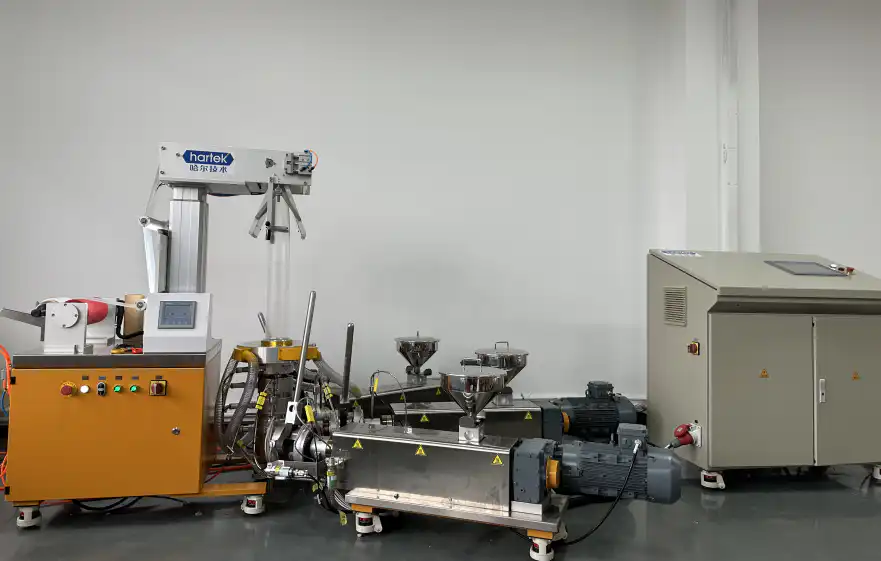
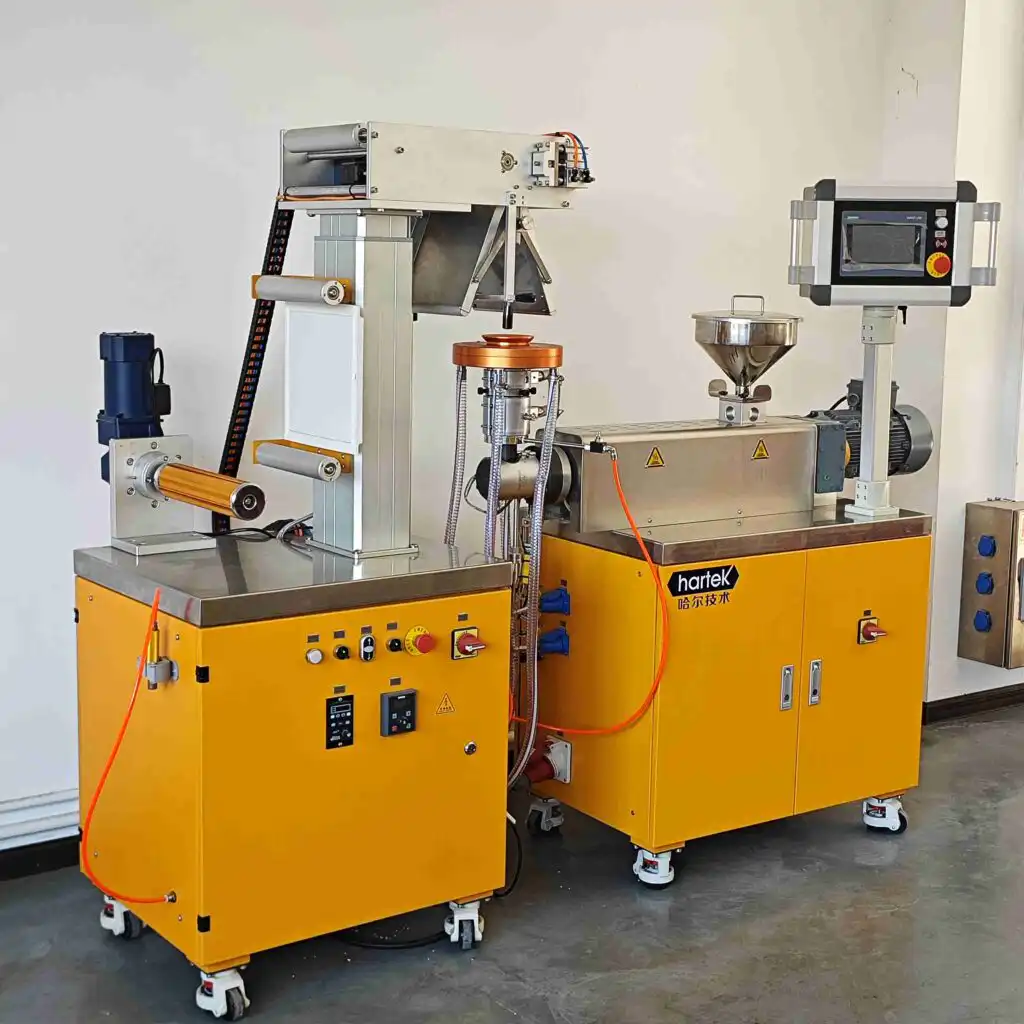
I. Core Features and Application Scenarios of Single-Layer Blown Film Machine Line
A single-layer experimental line typically consists of a single-screw extruder, die, air ring, traction, and rewinding units.
- Advantages:
- Cost and Efficiency: Equipment purchase and maintenance costs are significantly lower than multi-layer lines, making it more suitable for laboratories with limited budgets. Material replacement and cleaning are convenient, enabling rapid preliminary film-forming property assessments of different formulations or new materials.
- Focus on Process Variables: Focuses on the melt flow, stretching, and crystallization behavior of a single material system. It can efficiently investigate the influence of basic blown film process parameters such as screw speed, extrusion temperature, blow-up ratio, and traction ratio on the mechanical and optical properties of films.
- Simplicity and Reliability: Low operating threshold, relatively easy-to-control process stability, suitable for basic teaching, routine material performance testing, and simple product prototyping.
- Main Limitations: Cannot prepare films with multi-layer structures. Difficult to evaluate adhesive layers, functional layers, or complex barrier structures.
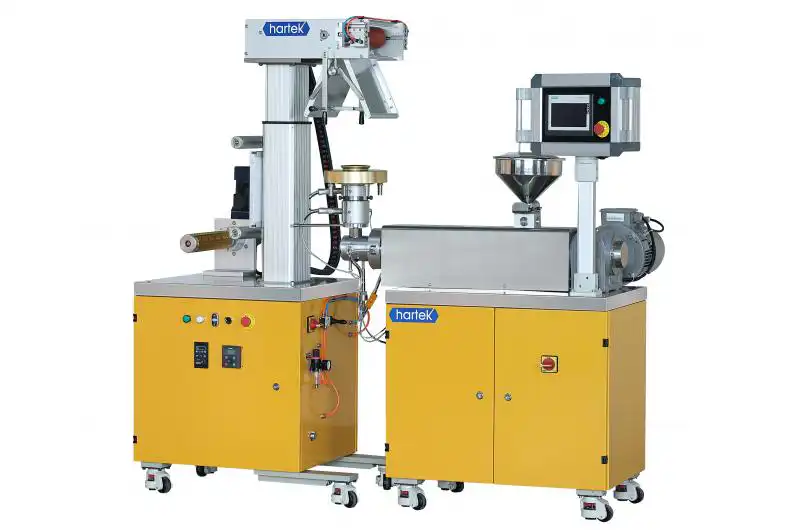
II. Core Features and Application Scenarios of Multilayer Co-extrusion Blown Film Experimental Line A multilayer line is equipped with at least two extruders. Through multilayer co-extrusion dies, it can produce three-, five-, or even more layered film structures.
- Advantages:
*Structural Design and Simulation: The core value lies in simulating multilayer structures (such as ABA, ABCBA) in actual production, enabling the development of functional composite films with high barrier properties (EVOH/PA layers), preservation properties, and UV resistance. It allows for the study of key issues such as layer-to-thickness ratio, interfacial compatibility, and interlayer adhesion.
*Resource Optimization Validation: Allows for the validation of “functional layer/base layer” design concepts on an experimental scale. For example, it allows for the co-extrusion of expensive high-barrier materials with inexpensive polyolefins, optimizing cost structure while meeting performance requirements.
*Process Complexity Research: Allows for in-depth investigation of the convergence behavior of multiple melt streams within the die, interlayer stability control, and the interaction of materials with different rheological properties during co-extrusion.
- Main Limitations:
*Cost and Complexity: Equipment investment, land area, and energy consumption increase significantly. The operation and process debugging are complex, and material changes are time-consuming and labor-intensive.
*High requirements for R&D capabilities: A deeper understanding of the rheological matching and interfacial interactions of each layer of material is needed, demanding higher theoretical and operational skills from R&D personnel.
III. Key Decision-Making Points Based on R&D Needs Selection should not be based on the advancement of equipment, but should be fully defined by the R&D objectives.
- Typical Scenarios for Selecting a Single-Layer Blown Film Machine:
*Basic Assessment of New Materials: Initial screening of the film-forming properties, basic mechanical and thermal properties of a new resin or blend.
*Basic Process Research: Systematically studying the processing-structure-performance relationship of a single material system and establishing a basic process database.
*Development of Specific Single-Functional Films: Such as focusing on the processing stability and performance optimization of a single biodegradable film (e.g., PBAT/PLA).
*Teaching and Routine Testing: Used to cultivate trainees’ basic operational skills or to verify the performance of incoming materials using blown film technology.
- Typical Scenarios for Selecting a Multilayer Co-extrusion Blown Film Machine Line:
- Composite Structure Development: Clearly aimed at developing films with two or more layers, such as a “barrier layer/adhesive layer/support layer” structure.
- Interface and Compatibility Research: Core topics include interlayer adhesion mechanisms, compatibilizer effectiveness evaluation, and interface stability control.
- Pilot Production and Simulation: The experimental phase needs to realistically simulate the complex structures of future industrial production to provide direct data for scale-up.
- Resource Efficient Utilization Research: Verifying the feasibility of placing functional masterbatches or materials only in specific thin layers.
In selecting a blown film machine, the objective should be determined based on the product of the R&D project. If the product is a single material or only the properties of the matrix material are considered, a single-layer line suitable for basic verification should be selected to avoid over-configuration. If the core of the R&D lies in “structural design” and “interface control,” a multilayer line should be selected. Comprehensive research institutions can choose a highly flexible single-layer line for extensive preliminary screening and basic research, while also equipping it with a modularly designed multi-layer line (such as a three-layer line) for in-depth structural development, thereby achieving the optimal allocation of R&D resources.
 English
  Arabic
  German
  Spanish
  French
  Russian